
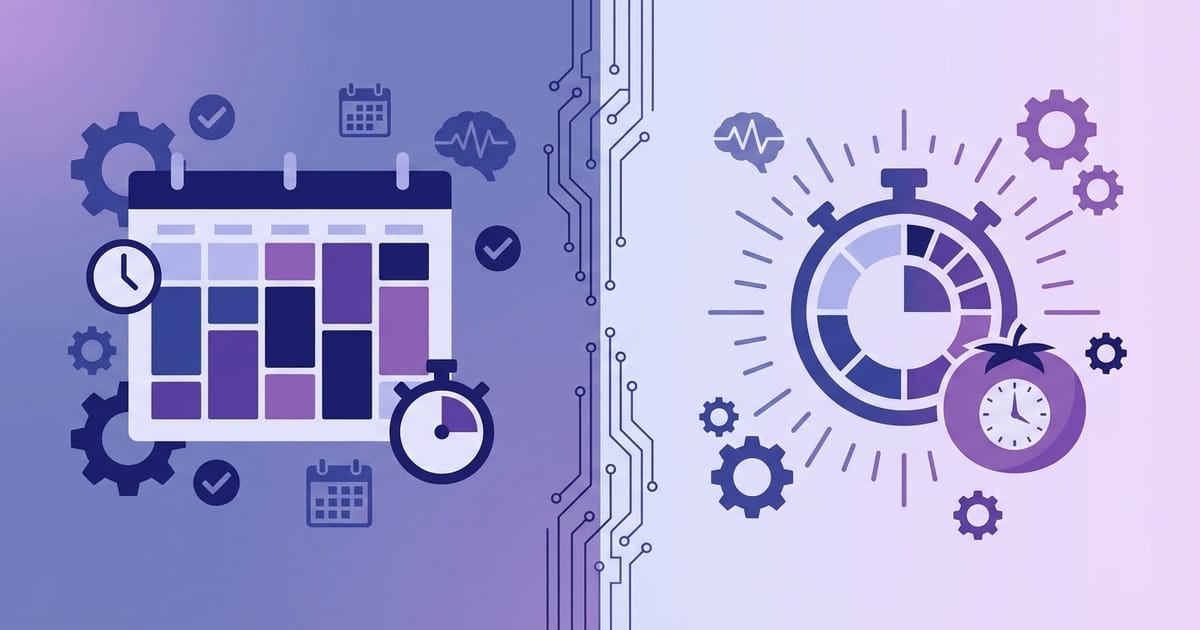
Time Blocking vs Pomodoro: I Tested Both for 6 Months
Productivity Twitter loves to argue about time management systems like they're political parties. Team Time Blocking versus Team Pomodoro, with passionate advocates swearing their method is the only way to get things done.
I spent 6 months actually testing both approaches instead of just picking sides based on which one sounded cooler. Here's what I learned.
What I Actually Tested
Three months of strict time blocking: every hour of my workday planned in advance, specific tasks assigned to specific time slots, calendar as the single source of truth for what I should be doing.
Three months of Pomodoro: 25-minute focused work sessions followed by 5-minute breaks, longer 15-30 minute breaks every 4 sessions, task list separate from time slots.
I tracked everything: how much deep work I accomplished, stress levels, how often I stuck to the system, and overall satisfaction with my workdays.
Time Blocking: The Planning Enthusiast's Dream
Time blocking felt like playing Tetris with my calendar. Every task gets a specific block of time, and the goal is fitting everything together into a satisfying, organized whole.
What worked well: Having a plan for every hour eliminated decision fatigue. No wondering "what should I work on next?"—just look at the calendar and follow the schedule. Great for days with lots of meetings and varied tasks.
Time blocking forced realistic time estimates. When you have to physically fit tasks into calendar slots, you can't pretend that rewriting the entire marketing website will take 45 minutes.
What sucked: Life rarely follows the script. Meetings ran long, urgent issues popped up, and creative work didn't respect the arbitrary boundaries I'd drawn around it. I spent almost as much time re-planning my calendar as following it.
Buffer time helped, but then what's the point of detailed scheduling if you're padding everything with "probably this will take longer" time?
Best for: People with predictable schedules, lots of administrative tasks, and strong planning skills. If your work is mostly known quantities (emails, reports, meetings), time blocking provides excellent structure.
Pomodoro: The Focus Purist's Choice
Pomodoro is beautifully simple: work for 25 minutes on whatever's most important, take a break, repeat. No complex scheduling, just sustained attention on one task at a time.
What worked well: The forced breaks prevented the "I've been coding for 4 hours straight and my brain is mush" problem. 25 minutes is long enough for meaningful progress but short enough that starting doesn't feel overwhelming.
The timer creates external pressure that helps overcome procrastination. Something about the countdown makes it easier to resist distractions.
What sucked: The rigid timing felt artificial for many tasks. Sometimes I'd hit flow state and the timer would interrupt right when I was making breakthrough progress. Other times, 25 minutes wasn't enough to even understand a complex problem.
The breaks often felt forced, especially when I was engaged and wanted to keep working.
Best for: People with attention issues, creative work that benefits from regular mental resets, and tasks where you struggle with procrastination or getting started.
My Actual Results (With Data)
Deep work hours per day:
Time blocking: 4.2 hours average
Pomodoro: 4.8 hours average
Tasks completed per day:
Time blocking: 7.3 average
Pomodoro: 5.1 average
System adherence:
Time blocking: 67% (followed schedule as planned)
Pomodoro: 84% (completed planned number of sessions)
Stress levels (1-10 scale):
Time blocking: 6.2 average
Pomodoro: 4.7 average
Pomodoro won on deep work hours and stress levels, but time blocking was better for administrative productivity and task completion.
What I Actually Use Now (The Hybrid Approach)
Plot twist: I use both, depending on the type of work I'm doing.
Time blocking for: Days with lots of meetings, administrative tasks, and varied work types. When my calendar looks like Swiss cheese with scattered appointments, time blocking helps organize the gaps.
Pomodoro for: Deep work days, creative projects, and tasks where I need sustained focus. When I have large blocks of uninterrupted time, Pomodoro helps maintain intensity.
Neither for: Light admin days or when I'm in crisis mode dealing with urgent issues. Sometimes the best system is no system.
Modified Versions That Work Better
Flexible time blocking: Block types of work, not specific tasks. "Morning: deep work," "Afternoon: meetings and email," "Evening: planning." Provides structure without brittleness.
Longer pomodoros: 45-90 minute work blocks instead of 25 minutes. Better for complex tasks that need longer startup time. I call them "flow blocks."
Energy-based scheduling: Match task types to energy levels instead of arbitrary time slots. Hard thinking in the morning when I'm fresh, routine tasks in the afternoon when focus wanes.
The Real Lessons
Context matters more than methodology. The best system depends on your work type, personality, and external constraints. Someone managing a customer service team needs different tools than a novelist.
Consistency beats perfection. Following a simple system 80% of the time produces better results than a perfect system you abandon after two weeks.
External pressure helps. Both systems work partly because they create artificial constraints. Deadlines and timers motivate in ways that pure willpower doesn't.
Breaks matter. Both systems emphasize rest and reset periods. The specific timing matters less than actually taking breaks.
My Honest Recommendation
Try Pomodoro first. It's simpler to implement, requires no complex planning, and teaches you about your natural attention patterns. Use a basic timer app and focus on building the habit of sustained attention.
If Pomodoro feels too rigid after a month, experiment with time blocking. But start simple—just morning/afternoon blocks instead of hour-by-hour scheduling.
Most importantly: pick one system and stick with it long enough to actually evaluate its effectiveness. A mediocre system used consistently beats a perfect system used sporadically.
The goal isn't finding the perfect productivity method. It's building sustainable work habits that help you accomplish your actual goals with less stress and more focus.